Sunday, June 28, 2015

ME AND EARL AND THE DYING GIRL review


There's a fine line between genuine sweetness and a sweetness that's more saccharine; "Me and Earl and the Dying Girl" straddles that line so much to the point where it really works for some people, but not so much for others. And one can understand the argument for both sides, really. This movie came out to great acclaim at the Sundance Film Festival where it won the top prize, and you can kinda see why. The movie definitely has no shortness of charm; from the very beginning, it takes a very sardonic approach to the way it tells the story. Complete with captions like "This is the part where I start senior year of school" or "This is the part where I meet the dying girl." The movie has an overt self-awareness to it; it's very deliberate in its standoffish-ness because it's told strictly from the point of Greg (aka "Me"), who's a pretty standoffish guy.

And yet. At the same time. Here we go... one can completely understand people who wound up being turned off by this film. That element of sweetness and standoffish-ness comes off in a way where it sometimes feels like it can't be trusted. The movie's perspective on Greg is often muddled. He's a very self-obsessed teenager. The only reason why he starts hanging out with Rachel ("the dying girl") is because his mother forces him to. His best friend Earl ("Earl") is someone he's hung out with since they were in kindergarten, but he refers to the man as his co-worker. To the film's credit, Greg is often called out for his dickishness. Earl pokes fun at him for his fear of being rejected. Rachel, at first, does not buy Greg's attempts at friendship whatsoever. She's going through enough already, having been diagnosed with leukemia, she doesn't need a self-obsessed egomaniac hanging around her all the time.

Even at 105 minutes, which is a fairly reasonable running time, no matter how often Greg gets called out for being so egomaniacal or petty or dickish, there's still a point where it all gets to be a bit much. Simply put: of the three main characters here, Greg's story and point of view is the least interesting. It really is. That doesn't mean the movie's running time should be equally dispersed to give the proper amount of time to Greg, Earl, and Rachel. But at a certain point, as Rachel's sickness worsens and the movie becomes clear that this is about how it affects Greg more than anything else, it's difficult to spend time with someone who makes everything about himself regardless of how often the movie calls him out on it. It's an inherent flaw that the film can't avoid, as long as it continues to intensely be about Greg.

Thing is, though, I didn't come away from the film hating Greg. Like I said, it's just difficult to spend a long period of time with anyone like that. Greg is a 17 year old kid. He's self-obsessed. Almost every 17 year old kid, if you make a movie strictly about them, will start to feel insufferable. It just so happens that Greg is especially insufferable even though he initially comes across as charming (as does the film itself). At first, it's kinda funny how he views his friendship with Earl. He and Earl both have a deep interest in cinema, thanks to Greg's father (Nick Offerman).

The two would intensely watch films by Werner Herzog or "The 400 Blows" or several other classic foreign films. They loved them so much they began to create their own stupid versions of those films. (Like, "Pooping Tom" as opposed to "Peeping Tom"). The whole thing's really just meant to be a joke between the two, but once Greg starts showing the films to Rachel and word gets around, a classmate suggests that he should make one of his stupid films about Rachel to cheer her up. Greg never officially agrees to do it and subsequently becomes obsessed with/angered by the fact that he's being forced into it. And again, it's this self-obsession. Despite the fact that Rachel's condition keeps getting worse, with Greg, it's more and more about his frustrations with making this movie for Rachel. The more he starts losing sight about the bigger picture, the more he started to lose me. The more his friendship with Earl didn't seem that funny anymore. The more his initial charm started to become cloying.. And thus, there's where that sweetness/saccharine fine line started exposing itself to me.

"Me and Earl and the Dying Girl" remains a uniquely made film. It has a very interesting visual approach and there's some unusual framing deployed that further brings home the point just how disconnected Greg feels with everybody. There's an excess amount of headroom when you're walking down the hallways with Greg. Close-ups where Rachel or Greg will fill in the last third of the frame, instead of the first third. I really responded to the style of the film... once again, at first. But no amount of style, whether it's the brief moments of animation or the Annie Hall-esque "scene that should've happened/scene that actually happened" play on formality, all of these things start to matter less when you're stuck in a movie where the lead character becomes more difficult to identify with.

Greg never needs to be likable. No character needs to be likable. But there are just too many elements to the story where I just started to lose my patience with Greg. It's funny because the movie may actually be one of the more realistic depictions of teenagers (or, well at least suburban white teenagers) in that it really nails down just how self-obsessed they can really be. Still, that doesn't make the movie any more fun to watch. Because he is the way he is, it makes Rachel's story feel more shallow. I ultimately didn't feel anything about her inevitable plight. There's a message in this film, "even when someone dies, there's still so much you can discover about the person," which at first seems like a nice sentiment, but Greg's realization of the message just made me want to strangle him. Because that's when I realized how little he attempted to know Rachel despite the 100+ days he spent with her. By the time he begins to realize just who she really is, the movie treats this as a big character moment for him.

And maybe he has become a better person after all is said and done. Maybe he's grown up and matured and will find a way to navigate college with a smile on his face. Maybe I'd watch a movie about the Greg that's learned not to be so self-centered. But, man, I can't say I enjoyed watching the process of him "growing up," especially when Earl and the "Dying Girl" are essentially tossed aside in the process. Yes, "Me and Earl and the Dying Girl" straddles that sweetness/saccharine line pretty intensely. Where does it ultimately lie? Well, it may have started to go down rather smooth, but by the end, I wished I had some mouthwash.

Grade: C+


Friday, June 26, 2015

7 MINUTES review

Review can be found by clicking this link:

http://blogs.indiewire.com/theplaylist/review-7-minutes-starring-jason-ritter-luke-mitchell-leven-rambin-zane-holtz-20150625

INSIDE OUT review


Twenty years after releasing their first film "Toy Story," it's only fitting that Pixar would make a movie that essentially boils down what a "Pixar movie" is all about. An image has been passed around Twitter over the past week that humorously pointed out that almost every Pixar movie released in the last 20 years has been about "what if [inanimate object/animal] had feelings?" Under "Inside Out" it said: "what if FEELINGS had feelings?" It's funny because it's true, but to say that is to be under the impression that the people behind Pixar don't realize that's what they're doing.

Because so many of us have grown up watching these Pixar movies, I think we forget one crucial thing: Pixar will always be about the kids. The fact that the studio has been able to create such unique and wonderful films, while still making variations of the same formula, that's not really something to be ashamed of. "Inside Out" breaks down the Pixar formula to its purest state, the movie is an exploration of the formula. It's a movie intended to make you laugh, cry, and feel all warm and gooey at the end and like several other Pixar films, it succeeds brilliantly.

For being a movie intended mainly for kids, "Inside Out" is really quite ambitious. We watch this girl, Riley Anderson, go from being a newborn to 11 years old. But this movie is moreso about Riley's feelings than anything else. Her feelings are personified as such: you have Joy, Fear, Disgust, Anger, and Sadness. Joy is kind of the leader of the group and has been with Riley from the beginning. While she has formed a strong, sometimes contentious bond with Fear, Disgust, and Anger, she continually disallows Sadness from interfering with Riley's day and her memories. But Sadness becomes more difficult to handle when Riley and her family move from Minnesota to San Francisco. Suddenly, all of Riley's friends are gone and her new home isn't exactly what she had in mind.

Once Sadness begins playing around with Riley's core memories, the memories that most help to shape who Riley really is, Joy gets in a fight with Sadness until the two are sucked up into a different part of Riley's consciousness. Eventually, Joy comes to realize just how vital Sadness is to the group and that Riley needs Sadness to continue to grow in life. Together, with the help of an ol' imaginary friend of Riley's, Joy and Sadness must find a way to get back to "headquarters" in order to help Riley deal with her pain.

It's a very simple, yet poignant message that co-writer/director Peter Docter explores here. Of course we need both happiness and sadness in order to live a complete life, but this is something we often have difficulty coming to terms with during our adolescence. Why else do we struggle so much during our pre-teen years (and sometimes for many years after)? Things change. Our childhood is over. We learn the hard truths about our life. We learn one day we'll die, our parents will die, everyone will die. We need sadness to help us come to terms with such harsh realities. Again, the message might be fairly obvious to us adults, but it's an especially deep and profound message to tell kids. As for those who have been through that stage in life, it's simply something that rings true.

Praise must be given to the animation of both Riley's consciousness and the real world. The world of San Francisco is all reflected through Riley's experiences. And the animators add so much color and beauty to Riley's mind. Very strong, primary colors that counter-balance the grays that we see in the real world. The movie's voice casting is another stroke of genius. There's Amy Poehler as Joy, which makes perfect sense. Mindy Kaling as Disgust, Bill Hader as Fear, Phyllis Smith as Sadness, and Lewis Black as Anger. Really inspired stuff right there.

If the film had a weakness, it would be with Riley's actual storyline, but this is pretty understandable. You're kind of throwing a lot out there for kids to take in. There's a lot to explain when it comes to what's going on inside Riley's head and the movie is really more about the struggle between Joy and Sadness. While we put up with way too many unwarranted sequels these days, I would totally dig an "Inside Out 2." Now that we fully understand the inner-workings of the mind (according to this world), there's so much more that you can do with a sequel. Plus, they introduce a "puberty" button towards the end of the movie that's just begging to be pushed at some point.

All Pixar movies, or at least the best ones, are pretty shameless when it comes to exploring the sentimental aspects of the story being told. You think of "Toy Story 3" or "Up" or "Finding Nemo." They all deal with equal amounts of joy and sadness. "Inside Out" strips away any pretension and deals with these emotions head on. And through that, it tells us that they keep using this formula because it works. Most of the time, it works with adults, but it especially works with children. As parents, we often try so very hard to keep our children from feeling sad, or at least letting them talk through their sadness and get a deeper understanding of who you are. Basically, Pixar uses this formula to do a job that parents are too afraid to do. A point very well taken, Pixar.

Filled to the brim with ambition, but never forgetting to bring the humor. There's just something very awe-inspiring and wonderful about a movie that so intensely explores the mind of a young girl. So much of the time animation deals with the fantasy. A great majority of Disney movies are about princes and princesses. Here's a movie that's strictly about the perils of growing up, moving away, and trying to cope with change. And it deals with these issues by exploring feelings and how they work. I laughed quite a bit while watching "Inside Out," but I also felt sad on occasion and even had tears come to my eyes during certain moments. And you know what? In the end, it all felt pretty damn great.

Grade: A-


Sunday, June 21, 2015

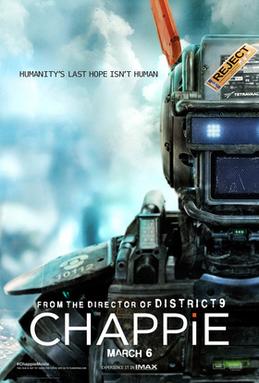
I rent, I watch, I review: CHAPPiE


So there's good news and bad news. Good news: I enjoyed "Chappie" a bit more than Neill Blomkamp's previous film "Elysium." The bad news? "Elysium" wasn't very good. In other words, "Chappie" being a bit better than "Elysium" doesn't mean that it's a good film. We're talking different levels of mediocrity here and "Chappie" just happens to be on a higher level. But, it's still pretty mediocre and sometimes it's outright bad. Get it? Got it.

One issue with "Chappie" that's impossible to ignore is the cast. The movie features Hugh Jackman and Sigourney Weaver, but their roles couldn't be more perfunctory. Hugh Jackman has more screen time and is essentially the villain of the movie, but he's got to be one of the most one-note villains I've seen in recent memory. His character, Vincent Moore, has created a giant robot called MOOSE which is a rival bot to Deon's. Deon (Dev Patel) is responsible for creating attack robots that are used as police force, rendering Moore's MOOSE unnecessary. 

Jackman essentially has nothing to do for the first 2/3rds of the movie but to act really pissed off that his robot isn't being used. He has no other aspect to him. He and Deon work in the same office together and at one point he actually pulls a gun on Deon in the office and threatens him. Nobody in the office says or does anything. Why am I bringing that particular scene up? Because what the hell does he do in that office other than continually get pissed off? If his MOOSE project doesn't work, what the hell is he there for? Moore, for much of the movie, has this little B-plot that really seems to get in the way from what this movie is supposed to be about. I wish his storyline was excised almost entirely.

Because the main plot, the plot concerning the title character Chappie, is a hell of a lot more interesting even if Chappie is the sum of several different robot movies. Deon created Chappie after creating a "consciousness" file, as an experiment, that Deon could upload into a robot that was otherwise going to get discarded at Deon's job. Next thing you know, Chappie is alive. But, there's a whole other element to this.

Before Deon can finish making Chappie, he gets held up at gunpoint by these South African gangsters who want to force Deon to turn off all the robotic police. But he's in the middle of creating Chappie and convinces them to let him complete making this robot instead, even if it means this new AI would be working for these gangsters (played by South African rap group Die Antwoord). 

Die Antwoord (who comprise of Ninja and Yo-Landi Visser) get a significant amount of screen time in this film. I'd argue they get the most screen time aside from Chappie. And this is a near-fatal mistake as they're not very good actors. They play versions of themselves, gangster versions. And while Yo-Landi demonstrates patience as she tries to teach Chappie, as Chappie essentially begins life as a newborn baby, Ninja has very little patience for the AI. Ninja has his own problems, namely having to give a rival gangster tens of millions of dollars by the end of the week. The character (and the actor) is just painful to watch the entire time. Yo-Landi does a little better except when she's put in more dramatic scenes, then she falls completely flat on her face too.

Yadda yadda yadda. This is a rental review so excuse my excessive informality, but essentially, what the problems of "Chappie" boil down to is that there are way too many plot points here that take away from the main story. Vincent Moore has his MOOSE program. Ninja and Yo-Landi owe money, lots of money. But the heart of the movie is Chappie and we have to sift through all this other plot bullshit while we watch Chappie grow and utilize his consciousness.

It's almost as if Blomkamp was afraid to fully commit to exploring the growth of this AI. Yeah, it's been done before, but he can still grow up in this gangster environment and that could be an interesting twist to the idea. There's still plenty of things you can do there, interesting things. But instead, because Ninja worries so much about his own problems, he's completely unwilling to teach Chappie anything, neverminding the fact that this is the FIRST AI CREATED in this world! Ninja immediately acts like a deadbeat father to an AI that picks up on everything everybody teaches him. Does Ninja naturally have a "deadbeat father" gene? What gives? Like "Jurassic World," it's one thing to have dumb characters, but characters this stupid really drag the movie down. Add Ninja's terrible acting to the equation and it just becomes unbearable to watch this all unfold.

What saves "Chappie" in the end is a pretty electrifying third act that finally cuts all the pretense and gets these characters in action. I am not one to clamor for action all the time but when there are so many poor story and character elements in a movie, action's the only thing it's got left. And "Chappie" delivers on that front. Almost too well.

Blomkamp has shown with his movies thus far that he's not afraid to get ultraviolent, but it's a bit shocking to see a character get pulled apart in half in a movie like this. A movie that never hints that such ultraviolence could occur. But once Chappie has finally learned as much as he needs to learn and he has purpose within the story, that's when things start to come together and allows for such great action to follow.

I just wish the director spent more time crafting a story that was more compelling in the first 2/3rds. Otherwise, the movie essentially works because all the not-so-thrilling elements early on in the story actually add up to something fairly thrilling in the end. There are plenty of low moments in the film, moments where I cringed, but I'd be lying if I told you I wasn't sucked in at the end. So, kudos for that. Doesn't make "Chappie" a great movie, or even good. But it's a weirdly entertaining film when all is said and done. I can handle weird. I'll take weird over "film made by committee with zero personal touch" any day. At least this feels like a Neill Blomkamp film, for better or worse. I know that's setting the bar fairly low, but I'm just trying to find the silver lining in Blomkamp's career. I think he has interesting ideas, he just has to implement them in a way that makes such ideas feel new. Also, please don't cast Die Antwoord in your future movies, Neill. Thanks.

Grade: C+ 


Saturday, June 20, 2015

I rent, I watch, I review: 50 Shades of Grey


I expected very little from renting "50 Shades of Grey" this weekend and I got even less than that, unfortunately. No perverse thrills. There isn't even much in the way of kinky sex. The movie holds the promise over your head that the mind of Christian Grey will be uncovered to reveal a dark, twisted, depraved man. In reality? He's just kinda emo, really. He happens to own a bunch of whips, chains, belts, cable wires, tape, etc that he uses for pleasure, but he personally doesn't appear to find much pleasure in it. There's promise that there's an interesting fellow behind Christian Grey, but the movie never makes a compelling case for him.

Dakota Johnson plays Anastasia Steele (no relation to Lexington Steele). She's an English Lit student who interviews Grey for her school paper as the very rich Christian Grey has been picked to give a speech at her college's graduation. Steele apparently found her first meeting with Christian to be quite arousing, but you would be hard-pressed to discover that while watching their first scene together, as there's hardly any chemistry there. After their initial scene, Christian aggressively pursues Ana. But before they can officially begin an official relationship, Christian demands she signs a form of consent. This form basically allows Christian to perform all the kinky shit he wants to perform on her.

No chemistry between the leads isn't the only thing that makes the largely sanitized kinky sex a hard sell, Jamie Dornan's wooden performance is also a huge problem. He plays Christian Grey and he's really kind of small. Nothing about his stature suggests a powerful, dominant man. Sure, he's got the typical good looks, even a bit of a six pack. But unlike Christian Bale in "American Psycho," it's hard to buy that he's legitimately into some fucked up sex stuff. It's not his fault he's given several cringe-worthy lines of dialogue that he has to spew throughout the movie, but man, he just can't deliver. He seems completely devoid of a personality. Honestly, he seems kinda boring and stiff. What does Ana see in him exactly?

Dakota Johnson does the best she can, but the script doesn't allow her much freedom. Apparently, the only direction she's given is to bite her lip whenever she's near Christian. Seriously, she apparently bites her lip every five seconds. How do I know? Because Christian Grey says, "You're biting your lip" every five seconds.

Take away the promise of kinky sex and what you have is a very dull and practically plot-free romantic "drama". Even worse, the movie ends at the moment where things actually seem like they're about to get interesting. There's no drama, there's no building of tension. The climax that occurs towards the end feels like a giant tease. This is the moment where we find out just how messed up and depraved Christian is and he... whips Ana a few times. That's it? That's what this has been building towards? And we're given nothing that clues us in as to why Christian behaves like this.

Ana seems pretty down with most of the kinky sex Christian's into, she just wants a relationship. Christian wants a sex toy. He sees Ana as nothing more than a sex object and is stunned when he discovers he may have some feelings for her. But the movie never really goes anywhere. It beats around the bush when it comes to these character's emotions, but it never clutches onto anything substantial. It's one giant tease.

Sam Taylor-Johnson must be given some credit for crafting a film that sorta emulates that David Fincher look. She captures the clean, yet cold nature of Christian very well and I thought the movie had some compelling moments from a visual standpoint. But beyond that, I at least expected to have fun at the movie's ridiculousness, and there were a few moments that made me laugh. I found the movie to be watchable, but never ridiculous. Never that fun. It was watchable, but I was glad when it was over. It just never gets as weird as you'd hope. It's funny because there were dozens of films like this made in the early '90s. We've become so sanitized and squeamish around sex these days that "50 Shades of Grey" is promoted as some sort of kinky sex blockbuster. Weak.

Grade: D+

Wednesday, June 17, 2015

SPY review


You kinda have to hand it to Paul Feig, the writer/director of "Spy." Feig is 52 years old and initially made a name for himself as the creator of the cult classic TV show "Freaks and Geeks." Creating "Freaks and Geeks," one of the greatest TV shows ever made EVEN if it only had 18 episodes, means I could never have any ill-will towards Feig through the rest of his career. And despite a bumpy start to his feature film career (his first two films, "I Am David" and "Unaccompanied Minors" were both critical and financial flops), he's enjoyed a career resurgence that does not appear to be letting up anytime soon.

It's hard for filmmakers these days to churn out hits, even harder to make those hit movies get critical respect. Feig achieved that gold with "Bridesmaids," which was produced by Judd Apatow and written by Kristen Wiig and Annie Mumolo (the latter of whom co-wrote David O. Russell's upcoming film "Joy," fyi). That film began a fruitful relationship between Feig and co-star Melissa McCarthy, who stole the show in "Bridesmaids" and even managed an Oscar nomination out of the ordeal.

Since then, while McCarthy has continued to find success as a bonafide movie star, Paul Feig appears to be the only filmmaker who knows how to use her correctly. He knows he can't just put her in contrived situations to wring out as much physical comedy as possible. He actually grounds her characters in reality, gives them an emotional center, while still allowing McCarthy to display her natural on-screen talent. Quite simply, Feig brings out the best in McCarthy and McCarthy probably brings out the best in him.

"Spy" marks the first film since "I Am David" where Paul Feig directed a movie based on his own script. It's a little surprising he doesn't write his own scripts more often because that's really where his strengths lie in this film. "Spy" starts out by establishing the relationship dynamics between Susan Cooper (McCarthy) and a very Bond-like Bradley Fine (Jude Law). While the film's opener has Fine roaming down hallways, shooting down bad guys, the film's emphasis is more on the back-and-forth between him and Cooper.

Cooper is at the CIA Control Center watching over Fine and giving him proper heads up whenever someone is coming after him. They are a perfect team. But more than that, it's made pretty clear that Susan Cooper has some major feelings for him and Fine just looks at her as nothing more than a helpful guide/good friend/co-worker. Clearly establishing the relationships between each of the film's characters and allowing them to grow and be funny is what makes "Spy" so watchable. So when Fine accidentally shoots a bad guy while sneezing, a guy who was about to give him important information, you don't see it coming because you're actually invested in the characters/situation.

And as you're probably aware, at some point Susan Cooper is forced to become an on-field agent herself. Donning several different disguises and attempting to get some intel on some bad characters. Every move she makes is constantly being undermined by Agent Rick Ford (Jason Statham) who shows little respect for the work Cooper does. There are several moments where "Spy" really feels like a Jason Statham showcase - which is a good thing - but instead of showing us his skills as an action star, he actually demonstrates how his talents as a comedic performer.

So, yes, these are fun characters to watch and root for. Even the villains who are played by Rose Byrne and Bobby Cannavale have their fair share of good moments. But, the movie never really rises above typical spy movie plot points, which is kind of disappointing. And while Paul Feig seems to handle the action elements well enough, he's never really been a director who can demonstrate stylistic flare. "Spy" is just a bit too bland to be the slick spy comedy that it wants to be and I think the reason is because Feig treats the action moments in too much of a straight-forward manner. There are some highlights - like the fight scene that takes place inside a kitchen - but mostly, the action is never really played out for laughs. It's the moments between the action sequences, or a line here or there, that brings out the comedy, but certainly Paul Feig could have done more with these situations.

Ultimately, "Spy" kind of runs out of steam by the end. It has plenty of funny scenes and some cute scenes, but the "cute" scenes wear a bit thin after the 90-minute mark. Like, a scene featuring 50 Cent (as himself) getting run down by a CIA Agent (Miranda Hart) is not laugh-out-loud funny, but it's... cute. Then later, there's a second 50 Cent cameo that just runs that joke into the ground. Not so cute.

"Spy" just runs a little too long. It's 120 minutes, which is a pretty average runtime, but for a comedy that has a rather thin premise... you eventually start to feel the weight of those 2 hours. Shave this down to 105 minutes and this could've really fired on all cylinders. As it is, "Spy" is a pretty solid comedy that, by the end, just wears out its welcome a little too much.

Grade: B-

Tuesday, June 16, 2015

Jurassic World review


I honestly do not expect all that much from movies. If it's entertaining on the most basic level, then I'm pretty much on board. But "Jurassic World" had a lot going against it, for me, right from the get-go. Watching the film play out, my fears were confirmed: "Jurassic World" is an unnecessary film. Does it have a few fun action sequences? Yes. Some of it is pretty terrifying too. "Jurassic World" hits all the most basic spots that's required in a blockbuster film, but it's basically a re-molding and a re-telling of the events that took place in "Jurassic Park" only not nearly as memorable or as thrilling. And the thing is, you can't pretend "Jurassic Park" doesn't exist while watching the movie because "World" constantly reminds you about the superior film that came out 22 years ago.

Twenty years after the events of "Jurassic Park," the island has been reopened to the public. Now it's rebranded and is meant to be more exciting, and most importantly, safer than last time around. But, surprisingly interest in these dinosaurs have started to wane amongst kids so the CEO of J World (Irrfan Khan) and the manager Claire (Bryce Dallas Howard) have allowed the implementation of an even bigger, scarier, smarter, more intelligent dinosaur to be created. That would be the Indominitable Rex. 

Everything about this movie is just completely irrational. Every character, especially. Except for maybe Owen (Chris Pratt), an expert on velociraptors who has been training said dinosaurs to obey him. They're like wild dogs. Except they're totally not, but that's basically what they're supposed to be. Owen is sent to inspect this new I-Rex because Claire and the CEO have just now realized that the creation of this super-intelligent beast of a dinosaur may not be the smartest idea. Owen can't even confirm their fears when he reaches the I-Rex's cage, as the beast has escaped. Or has it? 

As you may suspect, insanity ensues.

Maybe if Jurassic World was created 100-200 years after Jurassic Park, this may all seem plausible, but we're talking a little over two decades here. This is a park ran by the dumbest people imaginable and they should all ultimately die a spectacular death. This is just a lesser film than "Jurassic Park" in every way imaginable. Does it have some of the goods? Sure. Is it a lot better than it could've been? Maybe? But nothing about this movie justifies the idea that it should exist. Kinda like how nothing could possibly justify the I-Rex's existence.

"Jurassic World" tries to covers its ass by adding in meta-commentary. The comparison of I-Rex to "Jurassic World" was a calculated move on the filmmakers' part, but there's not really a payoff there either. This is just a movie, that should've never been made, apologizing for its existence. But it still exists. You can't have your cake and eat it too, guys. 

The plot I described above doesn't even do it justice. There are so many shitty characters in this film that have absolutely no arc. Even Chris Pratt is basically just in "generic charismatic hero" mode all the time. It's hard to get invested in a movie where there's no characters worth the investment. There are no thrills to a movie when you can see all the calculations happening right from the beginning. The only truly suspenseful sequence involves dino-birds creating havoc amongs the park guests. That was pretty fun. But too often while watching "Jurassic World," I had the all too distinct feeling that I had seen all this before. It's the exact same set-up and payoff just with lesser characters and a director who isn't Steven Spielberg. 

Take your impressionable kids who never got the chance to experience "Jurassic Park" on the big screen. This is for them. And maybe it's for you too, if you just want to see dinosaurs create havoc for 120 minutes and that's all you care about. Clearly, that's the case as the film has just had the biggest worldwide opening weekend of all-time. And that's fine. So people got what they wanted. Universal Studios got what they wanted. What else is there to say? Nostalgia is one hell of a drug when it's the right movie at the right time. 

Don't get me wrong, I had some fun while watching this movie, but it just felt hollow. At no point did this feel like a film that deserved to exist in its own right. And for me, that's a problem, even if the film is fairly decent. It's passable, but I'm not going to reward the film too much for exceeding my very low expectations.

Grade: C