Showing posts with label jennifer lawrence. Show all posts

Sunday, December 15, 2013

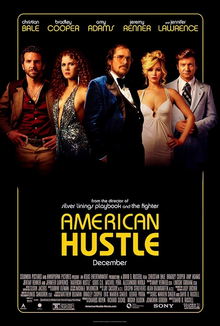
American Hustle is one fine piece of entertainment


David O. Russell is not the same director he used to be. Sure, he's brought elements of his style from his earlier four films into his last three (which include "The Fighter", "Silver Linings Playbook"), but they each have a more mainstream, crowd-pleasing quality to them. They're easier to swallow even if they still contain some elements of his trademark quirks. And look, there's nothing wrong with a good crowd-pleasing film. After all, that word isn't meant to be ironic. If it's pleasing crowds, it must be doing something right. Right?

Well, it doesn't always work like that, but Russell's films do. They are crowd-pleasing films in the best way, and even if they aren't all A-grade quality, they're still fun to watch. The one common thread that makes "The Fighter," "Silver Linings Playbook," and "American Hustle" fun to watch is the amount of attention paid to character. David O. Russell loves his characters, a lot. What sets "American Hustle" apart from the latter two films, and makes it A-grade quality, is how the worlds of each character seamlessly forms the plot. Whereas "The Fighter" and "Silver Linings Playbook" still had a lingering stench of formula to them (as much as Russell wouldn't want to admit it), "American Hustle" leads you down so many dizzying paths and roads and has a great time doing it. It's always funny, it's always charming, and while on the surface it would seem that it lacks an emotional punch that would bring it all together, it does have some interesting things to say that will resonate with you. The film is based on the FBI ABSCAM scandal that took place in America during the late '70s, but it's much more focused on the characters. Russell mines a lot of humor out of this material, while leaving room for some truly dramatic and tense moments to take place.

The key to "American Hustle" being so successful starts with the acting. Like with most of Russell's films, this film is for people who love great acting. Earlier this week, I saw Christian Bale in "Out of the Furnace" and he could not have been more bland. But David O. Russell is able to get so many interesting elements out of Bale in "American Hustle," which makes him so incredibly watchable. The difference is night and day. The same can be said for Amy Adams and Jennifer Lawrence, each of whom steal the show on a regular basis here. Bradley Cooper and Jeremy Renner help round out the cast. I liked the interesting line Russell kept having Cooper and Renner balance on. At first, you think Renner's character, Carmine Polito is only well-meaning on the surface, but you soon come to find that he really is who he says he is. Cooper's character, FBI Agent Richie DiMaso, also seems well-meaning on the surface, but soon reveals to be a bit of a con-artist himself.

Of course, he could never top the two masters of con-artistry: Irving Rosenfeld (Bale) and Sydney Prosser (Adams). We get to learn a lot about these two when the film first opens. Rosenfeld owns a few dry cleaning stores as well as a loan business that regularly cons people out of money. He meets Sydney at a party where the two bond over their favorite Duke Ellington record. They instantly strike up a connection and soon Sydney winds up being an even craftier con-artist than Rosenfeld could ever imagine. He's in love.

But he's also married to Rosalyn (Jennifer Lawrence). A stay-at-home wife who already had a kid when the two of them tied the knot. Irving willingly adopted him as if he was his own son and it's the son that keeps Irving from wanting to leave Rosalyn, despite there being no real love between the two of them. While Irving is out conning, Rosalyn's painting her nails, getting drunk, and setting things on fire. She's a bit of a loose cannon who insists on remaining married, despite how unhappy it makes the both of them. This continually drives a wedge between Sydney and Irving.

The wedge is driven even further when they find themselves on the verge of being sent to jail for their illegal practices. Richie DiMaso catches their loaning con in the act, and with the threat of a lengthy jail sentence lingering in their minds, they're both forced to work for the FBI using their conning skills against members of the New Jersey state government.

You know the statement "it took awhile for the film to get going"? That's usually said when the film's plot kicks in a little later than it should have. Well, the plot of "American Hustle" is deliberately put on hold so we can learn more about these characters. The movie is so well-written that when the plot finally starts to come into fruition, you hardly notice. David O. Russell writes these characters so beautifully, and they're each played by such gifted actors, that you would be willing to follow them wherever they go.

What's mind-boggling is that the actual plot to the film has a number of different complicated threads attached to it and yet everything comes together remarkably well. Even if there were some loose ends that weren't tied, because "American Hustle" is so character-based, it doesn't matter. There's still enough going on in this film, the plot is still continually moving forward, and it keeps you hooked throughout. There really isn't much more you can ask for in a movie.

I really enjoyed how this movie is essentially the anti-"Argo." Last year, there were three films that came out that cast the government in a pretty positive light: "Argo", "Lincoln", and "Zero Dark Thirty." I personally enjoyed each of those films, very much so. "Zero Dark Thirty" has a bit more ambiguity than the other two, but I realized with "American Hustle" that it's much more fun to watch a government agency get portrayed as a couple of sleazebags. They're not all terrible people, mind you, and the film places no emphasis whatsoever on depicting the FBI in a positive or negative light. They are who they are. Still, I liked that "American Hustle" was willing to get a little dirty. In exploring the different facets of corruption in government, "Hustle" actually tends to side with the corruptors. It shows how some of these people aren't willingly corrupt, a lot of them are just naive. Some of them are sad, lonely people. Some just want their share, they want a piece of the pie. "American Hustle" doesn't portray these individuals as great people either, it just portrays them as what they are. They're flawed individuals just like everyone else, they just happen to go a little too far.

In a way, everyone is a little bit corrupt. The world isn't fair. America isn't fair. Everyone has their chance to make it in this country, and a lot of people do it via illegal means. We see cases of this everywhere: in sports, in government, in business. Every day, we hear about this. The aim of "American Hustle" is to explore these kinds of people and see what really makes them tick. At the end, you come to respect Irving even with all of his faults. Not only is he amazingly crafty, but he does have a heart. It seems he got into conning people because he had an inherently cynical worldview, when it came to other people. But when he's introduced to Mayor Polito and sees just how genuine and good-natured he is, it melts his heart. He's finally met somebody he doesn't want to con, and in this occasion, he's being forced to by the government.

David O. Russell creates these characters who feel so much like real people (and well, they are based on real people) and he gives each character an honest moment of vulnerability. He presents them as one way at first, but then gradually reveals an emotional core that makes them seem human. It's an old trick, but it's a trick that never fails. And Russell knows that and exploits that for our entertainment. I wouldn't have it any other way.

"American Hustle" is an amazingly well-crafted piece of entertainment. Some will view it as a bit slight because it doesn't pound your head in with its ideas, but if a film does everything it sets out to do and it passes in every category, doesn't that make it a great movie? And it does have the necessary layers that makes it have more depth than what appears on the surface. It showcases the irony that a couple of con artists would be threatened by the FBI to con a mostly innocent, good-natured man which is much more dirty and seedy than anything they were doing in the past. The film is simultaneously both a celebration and an indictment of the sleazebag and it's a crowd-pleaser I have no problem getting behind. I can't wait to see it again.

Grade: A

Monday, December 2, 2013

"Catching Fire" review


It's tough to be in a situation like this. I assume a lot of people watching The Hunger Games movies do so because they like the books. Since college, I have watched way more movies than books. If you want to watch as many movies as I do, while still allowing yourself time to go outside and have a normal life, some sacrifices must be made. So, no, I have not read any of the Hunger Games books, but as I have preached countless times on this site: a movie is a movie. A movie should work on its own. No matter how faithfully a movie follows a book, the movie ultimately has to make some sacrifices in order for the material to make cinematic sense. In summation, this review doesn't go beyond what the movie provides. If anything, it's better that I haven't read the books because I can evaluate the movie purely on its own terms.

And judging the first Hunger Games movie based on its own terms, I maintain that it's a disappointment. Despite Jennifer Lawrence's strong performance, the movie ultimately felt bland. It held your hand through every single action beat or major plot development. Everything felt too calculated for the film to be enjoyable. The film, for me, doesn't work by itself. It may enhance the book for those who love the books, but that doesn't make for much of a movie.

Now I note these things in my original "Hunger Games" review, where I go further into detail about all that stuff. The reason why I'm rehashing those details is due to how much I actually enjoyed "Catching Fire." There were a couple of things I noticed in the second film that were major improvements from the first: the overall look, tone, style, and feel of the film felt much more cinematic. This felt like a big movie, as blockbuster movies should feel. The stakes were raised to the appropriate amount, so despite my relative lack of enjoyment of the first film, I was able to get on board with the plot of "Catching Fire" for the most part. Jennifer Lawrence was even stronger in this film than in the first and the film allowed some time for humor. Woody Harrelson was able to do more, and newcomers to the series such as Jena Malone and Jeffrey Wright added an extra dosage of energy to the proceedings. Josh Hutcherson still felt a little like a stick in the mud, a little wooden, but I enjoyed the way the movie explored the relationship dynamics between Peeta and Katniss. This is a couple that has to continue to put their "love" on display for all the districts and the capital and they struggle to make it look believable.

The events of the first film had consequences that I enjoyed watching unfold. President Snow (Donald Sutherland) is now watching Katniss's every movie after she more-or-less defied the Hunger Games by forcing them to pick two winners. He knows the truth behind Katniss and Peeta, that they aren't really in love, and he threatens to expose Katniss for who she really is. He also threatens to kill her family. Overall, Snow seems rather unamused as to what had happened in the 74th Hunger Games and has decided to bring in someone new to run the 75th games: Plutarch Heavensbee (Philip Seymour Hoffman). Together, they will run the Hunger Games' Quarter Quell. Every 25 years, a special version of the Hunger Games takes place. This time, all tributes are selected from the existing pool of victors from each district. Naturally, this means Katniss and Peeta will once again be fighting for their lives, but this version has them pitted against the best of the best.

It's a great way to up the ante, as it really puts Katniss's survival skills to the test. More than that, the film does a great job of making the Hunger Games look interesting, which was one of the problems I had with the last movie. Not only that, but we actually get legitimate surprises in these games. We don't find out why angry monkeys, tidal waves, and lightning is striking the games until the contestants figure it out themselves. There's real suspense here, and Katniss really seems to be outmatched and outwitted at times.

What also helps is how much we get to know of the other contestants. Aside from Katniss and Peeta, there's Beetee and Wiress, Mags and Finnick, and there's Johanna played by the aforementioned Jena Malone. Malone has a couple of scene-stealing moments in the film and is a welcome personality contrast to the often dour and grim Katniss. Katniss and Peeta form an alliance with these tributes, but Katniss begins to grow suspicious when everyone within the group is unusually helpful and kind to her.

The film does a great job of setting up the surprise that abruptly ends the film. I won't give away all the surprises, but suffice it to say, things take quite the left turn at the end when we realize that there's a lot more going on here than just the games taking place. Unfortunately, just when the film gets to its highest point dramatically, it ends. It just ends. From what I understand, the book pretty much ends on the same note, but the film takes so much time setting up the 75th Hunger Games that it's hard not to feel that the ending was rushed. It's such a halt in the action that it feels like merely one half of a whole story, and given that, it makes "Catching Fire" feel like half of an installment. The movie is 146 minutes long, and I guess the editing needs to be praised because it moves at a brisk pace. However, because the movie ends so abruptly, the ultimate experience felt a little underwhelming for me.

"Catching Fire," though, is such a marked improvement from the first film that I will eagerly await "Mockingjay Part 1" even though we all know the movie will end the same way. We also know that splitting up the final book is such a bullshit move and is a practice that needs to stop. When you split up a book, you're basically just making half of a movie. A movie needs some sense of emotional closure and "Catching Fire" does not offer that. "Catching Fire" is a series of great moments that does not add up to a complete whole. If this was a mini-series, it would be a great episode. But this is a movie, and every movie needs an ending of some sort. What we get in "Catching Fire" is not an ending, but merely a pause in the action.

Plus, Philip Seymour Hoffman and Donald Sutherland felt very underused in the film. Sutherland doesn't get to do much other than offer some very ominous dialogue, as with PSH. These are two masterclass actors and if they're going to be the primary "villains" in the film, then we need more from them than what we get here. I also don't buy Sutherland's character, Snow, being so easily fooled the way he is here. For a threatening, potentially violent President, you would think he'd be a little smarter as well and know when someone's pulling a fast one over him.

One thing that really eats at me with this entire series is just the logic that is presented in regards to the districts vs. the oppressive government. Holding a hunger games every year to suppress the districts' citizens is a bit of a stretch in itself, you would think pitting the districts' heroes against each other would cause some serious ruckus. And guess what? It does. But what's the point of that then? Does the government want these districts to stay alive? Do they want them alive, but weak? What exactly do they want with them in the first place? If you want to keep them from uprising, it seems unlikely that you would be able to hold a hunger games every year in order to make an example out of them. What, they're going to destroy each district that rises against them? Ok, so why have them around in the first place if you're going to continually provoke them? Perhaps the book explains it better, but again, this is an aspect of the movies that isn't covered well enough. Too much of this world is "assumed." Despite the film successfully upping the ante, it became harder and harder to buy this world with each plot development that occurs.

It's a testament to the filmmakers and the excellent cast, which also includes Lenny Kravitz, Stanley Tucci, and Liam Hemsworth who each have returned from the first film, that the film is still very entertaining in spite of its many shortcomings. I'm willing to cut "Catching Fire" some slack with its ending, after giving it some thought, but only if the subsequent films in the series can successfully carry over the stakes that were raised here. I'm giving this film a positive grade because it is a major improvement and is one of the better blockbusters to have come out this year. But, if the next two films falter, "Catching Fire" would no longer be worth watching. It's a good film, but needless to say, this series is on thin ice.

Grade: B