Saturday, November 16, 2013
So, the "Noah" trailer is in...
The first trailer for Darren Aronofsky's "Noah" was released this week and, um...
Look, I love Darren Aronofsky. He's grown on me. I was not in love with his style at first, but "The Wrestler" and "Black Swan" are brilliant. Both were my favorite films of 2008 and 2010, respectively. But... "Noah" doesn't look that great. Obviously, it's never smart to take a movie trailer too seriously, but this isn't a good start. It's not just that Russell Crowe looks bland, the whole movie seems kinda bland.
Who knows though? It can turn out to be great. The first trailer for "Pacific Rim" didn't look too hot either. I'm just saying, in all honestly, this particular trailer does not look good. We waited over three years for the next Aronofsky movie. Let's hope he doesn't disappoint.

Thursday, November 14, 2013
A note on historical accuracy

Historical accuracy in the movies doesn't really matter, except when it does. Then it definitely matters. Which is to say that it matters to a fault. There are a lot of indicators that come into play and, in the end, the question is never "was the movie accurate," the question is "did the movie work?" That's the only question that matters and it matters for every movie, not just ones that are based on a true story.
Writers and filmmakers are certainly allowed to take creative licenses in order to tell their story in a dramatic/entertaining fashion. Sometimes there's just not enough time to fit in every mundane detail. With a lot of films, there are events that just don't fit into the particular arc of the story. If the story is being told specifically through the POV of the protagonist, then some of the facts are most certain to be skewed. Films, by rule, do NOT have to be objective. As a matter of fact, the reason why it's dramatic in the first place is because of its subjectivity. You want the facts, watch a documentary. People should not be exiting a film, that's based on a true story, and trying to catch the film on any factual errors. It's a MOVIE! There are bound to be some factual errors because it's not meant to be an objective experience. Some films are able to be factually accurate, and that's great for them, but there's no law that says they have to be. The only thing that matters, once again, is whether or not the movie works. That's it.
Now, there are some exceptions to what I just said here. A great film is an experience that should resonate with you either emotionally, intellectually, or both. A great blockbuster film is great because it engages you in an emotional way, but in a more purely visceral manner. It may have great effects sequences or great action... when we have a positive experience with such a movie, it's because it has managed to engage us on some level. My problem with a lot of blockbuster films these days has nothing to do with the intellectual experience and everything to do with the lack of emotional experience. I don't go into a Marvel movie expecting everything to make sense, but I do expect it to be engaging on some level. The biggest way to get through to an audience is to skip all the pretense and go straight into what matters in the story. That's why "Pacific Rim" was such a positive experience for me. And on another, bigger level, that's how "Gravity" was for me. Two films doing decidedly different things, telling different stories, but both have the intention to engage with the audience. Both films cut through the excess fat and go straight to the meat of the story. By doing that, it lets the action sequences feel much smoother and have actual purpose.
Think of all the great action films of our time. Predator, Terminator/Terminator 2, Alien/Aliens, Robocop, Total Recall, Die Hard, Escape From New York, etc... Look back at all those films and what you'll find in common is not just awesome action sequences and fantastic thrills, you'll also find a through-line of simplicity. Now, Terminator 2 flirts with a more complex story, but generally speaking it keeps the main storyline in tact throughout. From the get-go, we are following the story, we know what's going on, we understand the characters, we're successfully immersed into this world and it allows us to really enjoy the film when it goes crazy with the explosions and the effects. What makes a bad action film is convoluted-ness. Elements thrown in that make no sense. Storylines that go nowhere. A lack of real emotional beats. All of that.
So wait, what does this have to do with historical accuracy? Well, a similar notion comes into play with movies that are based on a true story. The only thing that matters about films based on a true story is that it gets the basics correct. Like with "Argo," for example. Is it loaded with historical inaccuracies? Oh yes. But, is it about a guy posing as a movie producer in order to successfully get hostages out of Iran? Yes. The film is framed within the thriller genre so naturally things will be played up to make the film more exciting. For me, the movie works wonders when it comes to that. For me, I don't care if Canada didn't get mentioned that much, or if the plane ride wasn't actually as much of a nail-biter as it's portrayed in the film. It would be a much more boring film if told completely straight so the need to play up these moments make perfect sense. "Argo" works because it's a thriller, a great thriller. Thrillers, comedies, horror films... if the movie is based on a true story but is told in a specific genre, we have to expect some creative licensing will come into effect.
Another example would be anything Aaron Sorkin touches. Now, Sorkin is not a perfect writer, "The Newsroom" proves that. With the right director, Aaron Sorkin can sound like a genius. But without a great director constantly keeping Sorkin in check, things can get out of hand really fast. The reason why "The Social Network" worked so well for me, even if it may be historically inaccurate, is because of Fincher. The music of Trent Reznor alone should be a clear signal that the film is a dramatization, not a documentary. But Reznor's music and Fincher's filmmaking is so pitch perfect in the movie, that it all completely works. Sorkin's dialogue sounds great because Fincher was able to find the right tone and the right mood. That's because Fincher is the master of tone. Fincher is the modern master when it comes to thrillers, it's only natural that he's the master of tone. What I noted in my Social Network review, and why I docked it points, was because overall, these are a couple of rich, spoiled kids. Who cares about their problems, right? The beauty of Fincher, combined with Sorkin's script, is that it made me care for two hours. They convinced me to care. It wasn't until it was over when I realized how relatively inconsequential the actual story is, but that's because the film successfully took me under its spell. I've watched the film at least five or six times since and I still can't help but marvel at how well-made it is.
Now, here's the reason why I'm actually writing this piece. This year, we have a ton of films based on true stories. Dallas Buyers Club, 12 Years a Slave, Fruitvale Station, and The Butler for example. The first three films were great in my opinion. It's "The Butler" that I have a beef with. The reason why I'm bringing it up again is because The Hollywood Reporter had a "Writers Roundtable" where they gathered some of the most notable screenwriters of the year and had a lively, engaging discussion with them. THR does this every year with actors, actresses, directors, and writers. They usually pick the ones that are likely to have the most awards attention, and it's a fun thing to watch. You get to learn a lot about the process of being an actor, writer, or director and you get to watch pretty notable people interact with each other. It's great.
I wanted to write this because in the roundtable discussion, the subject of historical accuracy came up. Danny Strong, the writer of The Butler, happened to be one of the people who was being interviewed at this roundtable. When it was his turn to answer, he defended the screenplay to "The Butler," claiming that he never intended the film to be completely accurate and that it was a clear fictionalization of a true story.
See, I understand the man's point. I think he's right with what he's saying, and maybe it was Lee Daniels' not-so-subtle directorial style that made me feel that this film was more heavy-handed and superficial than it actually was. My problem with the film has nothing to do with historical accuracy and everything to do with what the writer chose as a replacement to the facts. I didn't like the changes. Plus, the film still says that it's based on true events. Not everyone knows who the real-life butler's name is, but the film doesn't attempt to clarify that at the beginning. My main problem is that the real-life butler's story, alone, is really pretty amazing. That's why Mr. Strong wrote the film in the first place, right? Because this dude survived through all these administrations and saw a lot of things? While serving the president, he saw all the changes his country went through from segregation to integration. Eventually, he saw a black man become President of the United States. That's an incredible story. Why do you need to add so much fluff? Why do you need to include this fictional family with a son that dies in Vietnam and another son that's involved in literally every single goddamn civil rights movement that occurred in the late 50s and throughout the 60s. I initially believed it because I didn't know what was real or not. If this was all true, if this butler actually had these sons and these things actually happened, it would be amazing. But, it was all falsified and that left me feeling so used.
The film has such heavy emotional beats when it depicts all these events. It makes you really feel for Cecil Gaines when he finds out his son dies in Vietnam. At the end, I couldn't help but think "man, this guy really had a rough life... and he was the butler of all these presidents." The main damn aspect of the story is basically a sidestory to this fictionalized aspect of the guy's life. Perhaps it wasn't made to be as important in the script, but the movie definitely goes out of its way to explore everything BUT his time inside the white house. When we're actually in the white house, more time is given for us to point at all the celebrities who are playing the Presidents. There is such little time spent actually going into Gaines's time in the white house... and it's the main reason we're watching the movie in the first place! That's why I hated the movie so much, it was a bait and switch act. If "Argo" claimed to be based on a true story and there never was a fake movie called "Argo" and there never was a dude pretending to be a movie producer in order to help the hostages escape... the movie wouldn't work. The BASIC facts must be there. You're selling this as "based on a true story" because the basic events that happen are so unbelievable that being reminded it actually happened makes everything feel that much more real and... believable. What the filmmakers choose to do with the information is completely up to them, as long as they keep the basics in tact. That's all I ask for. With "The Butler," so much extra bullshit was added that the main point of the story was no longer as important. That's a problem. That's when historical accuracy matters. That's when I start to feel cheated.
"The Butler" is a basic drama that tells the life of Cecil Gaines in Forrest Gump-like fashion. Seriously, if Forrest Gump was actually based on a real person named John Johnson and literally everything about Forrest Gump's personal life AS WELL as his personality was falsified... wouldn't that be the worst movie ever? Wouldn't you feel as if you were used emotionally so that a couple of sick-minded filmmakers could make the most overly-sentimental, manipulative film of all-time? Forrest Gump wasn't based on a true story though. It's a fictional, ridiculous character who ironically finds himself at all these historical moments in our country's history. It's a clever film, in that way. "The Butler" is the first movie I described. It's the overly-sentimental, manipulative one.
So, there. Ok? I just wanted to clear that up because I viewed the roundtable discussion about a week ago and it's been eating away at me ever since. I, personally, don't try to put a movie on trial when it's factually inaccurate. I only have a problem when a film uses the "based on a true story" BS and completely ignores the main aspect of the movie that makes the whole "based on a true story" tag relevant in the first place. OR, when the movie is so over-the-top and overwrought about the more sensitive aspects of the story it's telling that it winds up being overly-sentimental tripe. "The Butler" is both those things. That's why your movie sucked, Danny Strong.
Anyway, the roundtables are really fun to watch. I'll post videos to all the roundtables that have come out thus far, below.... each video is 50+ minutes long. Good stuff.
Here's the full Actors roundtable with Jake Gyllenhaal (Prisoners), Forest Whitaker (Lee Daniels' The Butler), Matthew McConaughey (Dallas Buyers Club), Jared Leto (Dallas Buyers Club), Josh Brolin (Labor Day) and Michael B. Jordan (Fruitvale Station).
The full Writers roundtable with George Clooney and Grant Heslov (The Monuments Men), Jonas Cuaron (Gravity), Julie Delpy (Before Midnight), Nicole Holofcener (Enough Said), John Ridley (12 Years a Slave) and Danny Strong (The Butler)
And, today, the Directors roundtable just came out, I haven't even watched it yet! This one features Steve McQueen (12 Years a Slave), Paul Greengrass (Captain Phillips), David O. Russell (American Hustle), Ben Stiller (The Secret Life of Walter Mitty), Alfonso Cuaron (Gravity) and Lee Daniels (The Butler)
Saturday, November 9, 2013
"Thor: The Dark World" review

When "Thor" came out over two years ago, the response was favorable but muted. It didn't go crazy at the box office, but it was solid enough. Personally, I thought it had its moments but, as far as Marvel movies go, I felt Thor's introduction was the weakest. Thankfully, one year later, "The Avengers" came out and was a smash hit. More than that, Thor actually wound up looking pretty damn good, and it got me excited about the character for the first time. He's actually pretty funny sometimes, and when used right, can be very effective. Even Loki came off much better in "The Avengers" even though I never thought of him as a serious enough threat to the likes of Iron Man, Capt. America, Hulk, and Thor. Still, even Loki managed to have a little fun. The question remained, how would that all carry over into the next Thor film? Would they try to build on the momentum that was built thanks to "The Avengers" movie or will "Thor: The Dark World" go back to the old, plodding ways.
The answer turned out to be both... kind of. The Thor sequel is a lot more fun and takes itself much less seriously than the first film, but the film's humor does little to mask the sheer amount of stupidity and nonsense that is prevalent throughout the film. Because the film has a humor about itself, much of the nonsense can be forgiven, but it gets frustrating when you get the feeling that the movie is literally making up the universe's rules as it goes along and that there doesn't seem to be one legit, tangible moment in the film. A character could have a dramatic death scene one moment and then come back to life the next, completely negating the earlier drama. Because Thor is a near-immortal god-like figure, it's hard for the filmmakers to give the character high enough stakes for him to succeed. You never feel like Thor is truly in danger, you find out in one scene that he can actually re-grow a hand, for crying out loud. What the hell is going on here? There's just never a sincere enough moment that could make you really care about his plight, or Asgard's plight. Thor is a god! He's going to be ok! Of course, it's a superhero, they're always going to be ok at the end, but you at least hope that this superhero will go through legitimate struggles. You wanna see Thor in serious harm's way so that it feels that much sweeter when he finally succeeds. You never got that in the first movie, and you don't get that here. What you get, ultimately, is a charming enough film with absolutely zero drama.
It gets to the point where you're thankful that the film allows time for some dumb, cheesy fun. Now, trying to explain the plot of the film is a fool's errand, so I'll be doing some heavy cribbing from wikipedia.org. See, unlike Rand Paul, I'll actually acknowledge when I'm taking the easy way out, but there's simply too much shit going on in Thor 2 for me to try to attempt to make sense out of it all. So, bare with me as I do some paraphrasing.
The Dark Elf Malekith wants to destroy the universe using a weapon known as the Aether. Bor, King Odin's father, was able to defeat Malekith and take the Aether away from him, later safeguarding it by hiding in a stone column. In present-day Asgard, all is pretty good. The Nine Realms are all peaceful, everyone's having pool parties and getting their freak on. Woo hoo! Actually, in Asgard, they like to have fun by practicing their sweet sword moves. Seriously, nobody here just sits down and relaxes. They're gods, why do they need to practice doing anything? Why not just eat all kinds of food, have orgy after orgy, and just have a hell of a good time?
Anyway, on Earth, Jane and her useless interns has been noticing some strange things have been a-brewing in London, England. Objects seem to be disobeying the laws of physics and are disappearing into thin air! Some objects will disappear in one end, and reappear in the other. Of course this makes Jane think of Thor and she snoops around, eventually getting herself into trouble by disappearing and re-appearing into another world. This world happens to be the one that holds the Aether and, despite Bor's best efforts to safeguard the damn thing, Jane winds up being consumed by the Aether pretty easily. Plot device activated!
Thor immediately senses something's wrong because, oddly enough, Heimdall has the ability to pretty much stalk anyone he wants while standing on the bifrost bridge. When he can't see her, and she reappears on Earth, Thor immediately goes to Earth to see what happened to her. And yeah, considering how easily Thor can go back and forth from Earth to Asgard, why can't he see Jane for two years? She's had this mind-blowing experience with this god and apparently he's hung up on the girl, but he can't sneak off and go see her? Also, what about the contractors on Asgard? Remember when all this shit was destroyed in the first movie and we all thought Loki might be dead because he, presumably, plummeted to his death? Well, seems like they all did a pretty damn good job making everything look exactly as how it did before. So, good job, guys!
I get it though. King Odin has probably been blocking Thor from seeing Jane, seeing as how she's a mere mortal and true love can never blossom between them. So, why not be with this other hot girl we keep putting the camera on, which is supposed to symbolize that she might be interested in you? Nah, Thor's all about Jane. Sure, she's in the middle of her prime and in about 20 years she won't look anywhere near as perfect as she does now, but so what? Thor is in love! Ok, I'm going way off track here.
Thor immediately takes Jane to Asgard, hoping his doctors can figure out what's wrong with her. He notices something's wrong when a police officer tries to touch her and gets blown halfway across town. The doctors can't exactly tell what's going on, but whatever's inside her is not good for her. In spite of the fact that it prevents rain from falling on her and she apparently is invincible, this energy inside her is "bad" so we won't explore it to its full potential. Wouldn't it have been cool if the Aether actually made Jane as immortal as Thor and they could maybe have a serious relationship together? And she has to have the very real, tangible debate within herself of whether or not she wants to leave Earth behind and stay with Thor for the next hundred years. Wow, that actually sounds dramatic and interesting. Naturally, this is never considered because, once again, this Aether being inside Jane is a mere plot device for Malekith to come to Asgard and destroy the universe. It actually has no real effect on Jane at all.
So, yeah, that's basically what happens. They find out it's the Aether, they fear for their lives and for Asgard and Thor attempts to come up with a plan to defeat Malekith and destroy the Aether forever. Meanwhile, the reason why things on Earth aren't obeying the laws of physics is because the Nine Realms are about to align. This brings about the only real interesting part of the film, a great fight sequence where Thor has to fight Malekith and his cronies and subsequently winds up jumping from realm to realm. It's a fun scene and is actually pretty clever, but once again, you just wish that it didn't all look so easy for Thor.
I can't go into my one biggest complaint and outcry with this film unless I spoil it severely so, if you don't want to be spoiled don't read the next three paragraphs.
When Thor goes into Malekith's world and tries to destroy him and the Aether, he brings along Loki (and Jane) because Loki's the only one in Asgard who knows a secret way to get there. On numerous occasions, Loki is told not to betray Thor by just about everyone in the film and there's a great sequence when Thor is flying through Asgard and into Svartalfheim where Malekith lives. But then Loki, surprise surprise, betrays Thor by stabbing him in the side and throwing him off the aircraft. Loki continues this "act" of betraying his brother in order to trick Malekith into drawing the Aether out of Jane. It works, initially, but Loki winds up being severely, perhaps fatally wounded when the attempt to destroy the Aether fails.
Loki looks up at Thor, seeming to be in near death, and they have an emotional moment before Loki passes on. Until the very end of the film, when after Thor tells his father Odin that he doesn't want to be king, it's actually revealed that Loki has taken the shape of Odin. Thor actually told Loki that he doesn't want to be king, not Odin! It's Loki! He tricked Thor! Thor has already turned and walked away when Loki reveals his true identity and this of course means that Loki will live to fight another day in the eventual third Thor movie.
To say the least, this has gotten pretty goddamn exhausting. Can Loki not die? Whenever Loki looks as if he's been killed, can we ever believe he's dead? Loki reappearing at the end effectively robs the movie of its only real emotional moment. And it reveals an unsettling reality about the Thor movies: Loki could, theoretically, never be defeated. Whenever we think he's about to die, it can turn out to be a trick. His specialty is trickery, after all. But this is like that 10 year old who's playing cops and robbers with you and everytime you shoot him with your imaginary hand-gun, he doesn't die. Dude, just play by the basic rules of "cops and robbers"! No, he has immunity. He's declared himself immortal, he can't die. Thus, rendering the game completely useless. This goes for the Thor movies as well. Apparently, the film's producers find too much value in Loki to actually ever kill him off. I don't know what game they're trying to play here, but you can't keep giving Loki serious death scenes and then taking them away, revealing he's not dead after all. Especially, when you're not going to reveal how he tricked everyone. It's stupid and it makes the Thor movies completely meaningless, as if they weren't meaningless already. It makes me seriously debate ever wanting to see another Thor movie again because if this shit is gonna keep happening, you can count me out.
Spoilers over.
And that's the problem with the Thor movies, overall. Nothing tangible happens in them. They're the worst kind of popcorn fluff. It has just the right amount of action beats to keep itself going and you can forgive much of its stupidity because, at least in Thor 2, it's at least playful about what it's doing. But these movies just don't work as a whole because without any moments where there are serious stakes at play, it's completely ineffective. If the action doesn't matter, then there's no reason to watch. If you're going to attempt to establish a set of rules for this movie and then subsequently subvert all of them, there's no real reason to watch this. The other Marvel movies, especially Iron Man, has a character that goes through actual struggles and he has serious foes. While not all the Iron Man movies are great, they at least work in its most basic function as superhero films. You have fun watching them and, by the end, it's a fun ride overall. The Thor movies is like a ride that promises to be an actual rollercoaster ride, but then turns out to be one of those cheesy simulator rides where nothing actually happens. It was...stimulating. But you ultimately get nothing tangible out of the experience. Your heart never races. You never have that exhilarating feeling of fear that's ultimately alleviated when you're allowed to get off the ride.
The Thor movies, "The Dark World" in particular, is just too vanilla. The reason why it's not a complete disaster is its sense of humor and the overall sense of fun it has with itself. It has its fun moments, absolutely. It's oddly enjoyable in some ways, but in the end, it's a dull, hollow experience. And, for a superhero movie, it's really kinda shitty.
Grade: C-
Friday, November 8, 2013
"Dallas Buyers Club" review
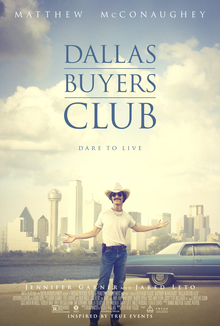
In "Dallas Buyers Club," Matthew McConaughey plays Ron Woodroof, a homophobic drug-addicted hustler whose spends his days either working as an electrician or going to the rodeo and his nights partying, having sex, drinking, and/or doing cocaine. When we first meet Ron, he's having his way with two women but he looks noticeably skinny and frail from the get-go. It's not until he has an accident at his day job when he finds out that he's tested positive for HIV. Not only that, but his T-cell count is very, very low and he's given just 30 days to live.
Shocked, angry, in disbelief, Ron initially dismisses such claims, arguing that only homosexuals get HIV/AIDS. But soon, after reading all kinds of AIDS-related material, Ron Woodroof begins to let reality set in and it's the kind of reality that few of us would be able to handle. The fact that he manages to pull himself together and survive for another seven years says a lot about the man. The fact that he's successfully able to smuggle unapproved drugs into the US and provide an entire Dallas community with these drugs----prolonging people's lives in the process---says even more about him.
But what's remarkable about the movie is the way the filmmakers refuse to paint Ron Woodroof as an absolute hero. While he eventually begins to soften up his view of homosexuals, as he supplies them with drugs (and profits off them, mind you), he's still the same hustler he's always been. He's still most interested in the keeping himself alive, first and foremost, as well as making some quick cash in the process. He goes from knowing absolutely nothing about the virus that's been living inside him to flying to Japan, Israel, and Germany in order to find the latest drug that can help. In order to evade drug dealing laws, Ron follows the lead of other cities and creates a "buyers club" in Dallas where people pay $400 to become a member and get the drugs that they need. I read one review where the writer complained that the movie never really lets Ron have a triumphant moment, but I think that's the point. I don't think Ron Woodroof ever realized the importance of what he was doing while he was doing it. He never has this big revelation, or this big change of heart, until the very end.
And really, even his change of heart feels muted and understated. What makes "Dallas Buyers Club" such a powerful film is its understated-ness. There are many times where the film could head into sentimental territory, much like Jonathan Demme's "Philadelphia" which has big emotional moments with Tom Hanks. "Dallas Buyers Club" is almost strictly about this business Ron creates and how this particular man suffers with such a deadly disease. Matthew McConaughey is the perfect man to play this Southern gentleman, but you'll be surprised at how far McConaughey goes here. McConaughey lost 38 pounds to play this role and you can feel his commitment to this character in every scene. He plays Ron with such great balance; he knew that if he ever overplayed his hand, it wouldn't work. He kept the character as consistent as possible from beginning to end, letting the subtlety of this character's growth really stand out instead of pointing out in very big ways.
A big part of why Ron Woodroof begins to soften his stance on homosexuality is his rude introduction to Rayon, played by Jared Leto. Rayon is transgendered, also suffering from the AIDS virus. Rayon has this cool, calm Southern drawl, and while Ron's repulsed by Rayon at first, he can't helped buy be charmed by him. He eventually lets Rayon in on his drug smuggling business because he knows Rayon would be much more successful in getting new clients. What he doesn't realize is how much he'll eventually care about Rayon and how important the mutual support and care they have for each other really is, until it's too late.
This Dallas Buyers Club has created a division among doctors, police, and the FDA. Dr. Eve Saks, played by Jennifer Garner, doesn't think so highly about what Ron's doing at first, but when she realizes how much more effective his drugs are than the FDA-approved AZT drug, she eventually starts to come around. Steve Zahn, who plays a police officer in the film, gets the Dallas police to back off Ron's business practices because Ron's able to supply him with a drug that can help his father's Alzheimer's.
Unfortunately, the FDA, the IRS, and other government organizations keep trying to shut down this buyers club. They have some legitimate reasons, mind you, but the lengths in which they try to go through will anger any viewer. Ultimately, what Ron is doing is helping hundreds of people and the drug approval process that the FDA goes through is so painstakingly slow that it'll kill millions of people before it helps anyone.
What "Dallas Buyers Club" is about is how one man's fight for survival affected an entire community, a community that this man would initially do anything to stay away from. While he still died seven years after his initial diagnosis, Ron Woodroof was able to die having found real purpose in his life. He was able to have some form of redemption even after living a wild lifestyle that rarely allows for such redemption to take place.
Director Jean-Marc Vallee, along with the film's screenwriters, do a fantastic job in finding the right balance to make Ron Woodroof really stand out as three-dimensional character. Matthew McConaughey gives the performance of his life here and makes this film so much more watchable than it already is. He's really become an exciting actor in the last few years, taking on more risky projects, and the most amazing thing is how it all seems so natural for him. You wonder why he spent so many years making formulaic romantic comedies, but now he has the kind of profile and box office clout that allows him to do a movie like this. "Dallas Buyers Club" is understated, yet powerful. The screenplay can be a little too on-the-nose at times and the ending may feel a bit too abrupt, but this is definitely a must-see. If anything else, it's worth it to watch McConaughey (and Jared Leto) give so much of himself to this role. Matthew McConaughey as Ron Woodroof is the type of performance you're not likely to forget long after the movie is over.
Grade: A-
Thursday, October 31, 2013
"The Counselor" review
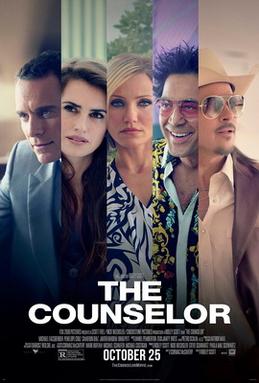
"The Counselor" is an enigma of a film. Anyone expecting an action-packed crime thriller will be very disappointed here because that's not exactly what "The Counselor" is going for. There are some thrills; there are some pretty gruesome death scenes, but this is a film that's more interested in the philosophical aspects of greed and extreme pride than a body count. Problem is, the end result does not add up to a competent, fully-functional film. By many accounts, it's an unquestionable failure, but goddamnit if it's not an interesting failure.
The Counselor, that is, the title character of the movie (Michael Fassbender) is a hot shot lawyer that plans on marrying his beautiful girlfriend (Penelope Cruz), doing so by proposing with a very expensive 3.5-carat diamond. He decides to get involved in a drug deal that apparently promises a four thousand percent return rate, a decision that his business associate (Brad Pitt) warns could wind up being an extremely dangerous venture, especially when dealing with Mexican drug cartels.
Murphy's law would look like a pleasant dream compared to what soon follows after the Counselor decides he wants in on this deal. Literally every aspect of this drug deal goes way wrong and suddenly the Counselor's life is in great danger. What makes matters worse is who the Counselor is actually up against. Throughout the film he has his chats with friend, Reiner (Javier Bardem), whose girlfriend Malkina (Cameron Diaz) is batshit crazy. Once Reiner's girlfriend catches wind up of this drug deal, all bets are off.
That's pretty much all that needs to be said about the movie's plot. I had a tough time recounting it all in my head because "The Counselor" doesn't really emphasize plot all too much. "The Counselor" is an exercise in bad behavior and the inherent punishment that coincides with such bad behavior. In The Counselor's world, it's not that these bad people can't survive without severe consequences, it's that everyone who meets their demise is ultimately too naive to know what's really coming to them. They're too smart, too prideful to realize that there may be someone else out there that's a few steps ahead of them. The film, in a heavy-handed manner, plays on a "hunter vs. prey" motif, symbolized by Malkina's pet leopards who remain a striking presence throughout the film. And while the ultimate lesson here, greed = bad, is a rather simplistic one when all is said and done, "The Counselor" is still intriguing in the way it explores its themes.
Unfortunately, one main flaw is the casting of Cameron Diaz as Malkina. Her character turns out to be the smartest person in the film, but the way Cameron Diaz plays her does not suggest that at all. She overplays her hand too often, trying to make Malkina seem menacing and sexy but instead goes way over-the-top. Reiner mentions how much of a psycho Malkina is, but Diaz plays that aspect of her character to the extreme, completely derailing the film in the process. Ultimately, she's just not convincing as a baddie and compared to the restrained performances from Bardem, Fassbender, and Pitt, she seems completely out of place.
Moreso than the poor casting choice, "The Counselor" is just way too heavy-handed thematically to be effective. It's too clever and cute for its own good and the lengthy dialogue is just not filmed in an interesting or cinematic manner. The film is devoid of subtlety and the end result is something that comes off as glib instead of entertaining. Its philosophizing too often comes off as being pretentious instead of something smart or insightful. It's clear here that Ridley Scott wanted very much to stay as true to Cormac McCarthy's script as he possibly could, but in doing that, wound up making a film that feels flat and un-cinematic. And we're talking Ridley Scott here. At his best, Scott is as cinematic as it gets even if his films in the past decade or so have been consistently underwhelming. The main commonality in all his films of late seems to be the lack of a coherent script. Here, the script is not incoherent, but it's definitely rife with problems that should've been easily solvable during the pre-production/development process. McCarthy is, first and foremost, a novelist. "The Counselor" is his first screenplay, as a matter of fact. So, one can understand the problem here. "The Counselor" probably reads much better as a novel, but as is, does not make for a successful adaptation into movie-form.
Still, there is indeed something quite intriguing about this movie, something that will make me want to revisit it in the near-future. It's definitely onto something. The way the characters match wits with each other can be pretty fun to watch and the film features a scene involving Diaz and a car that you will not forget easily. What we're left with is a film filled with such promise, it's just lacking the right execution to make it all work in the end. It's a bad film, but fascinatingly bad.
Grade: C+
Sunday, October 27, 2013
Blue is the Warmest Color review

How much is too much? That's a question that often gets asked when discussing films, especially films with controversial scenes. There are times when a discussion, on what is otherwise a great film, can be completely derailed because of a particular scene that stands out way more than the rest. And when the scene is extremely violent or sexual, it raises that question: how much is too much? For me, the question is slightly different. See, I think a film has the potential to go anywhere it wants to go, but it has to earn its way there. When Dennis Hopper's character in "Blue Velvet" huffs gas and stares between Isabella Rosselini's legs while saying "mommy"... that's a scene that will really stick out to anybody. Does the film earn its way there? For me, absolutely yes. The film successfully created this world where a character this deranged can exist. It was very carefully orchestrated and it's particularly unsettling and disturbing. Ultimately, it works.
A much better example, comparable to the film I'm about to talk about, is Irreversible's 8-minute long rape scene. Now here, the answer is much murkier. The film is unsettling in so many ways and you can argue that its rape scene is particularly effective because of how ugly and vulgar its depicted. But then you ask yourself, why must it be 8 minutes long? Why not 5? Or 2? At what point is the point getting across? Do we, as an audience, deserve some ounce of mercy? Gaspar Noe, the director of Irreversible, would probably answer no. And you know what? Fine. That can be a valid answer, but what does that mean for the actual film itself? Are you not doing your film a disservice when one particular scene is the only thing being talked about? With Irreversible, you could argue that the 8-minute rape scene is so powerful, so uncomfortable, so unnerving that it makes the rest of the movie "suffer" by comparison. Then again, that could also be the point. Watching the movie's main character, played by Monica Bellucci, later have more tender scenes with her significant other---it's completely marred by the fact that we know her character will later get raped. For me, while the scene itself is very unnerving and something I don't want to ever revisit, I understand its placement and how it serves the rest of the movie.
This brings us to the movie I'm supposed to talk about, Abdellatif Kechiche's "Blue is the Warmest Color." This three-hour French language film is largely a very moving, intimately-detailed romance drama about a teenage girl's first love. Thanks to the long running time, we really get to live with the film's main character, Adele (played by Adèle Exarchopoulos) as she goes to school, hangs with friends, eats with her parents, has a brief fling with a guy, etc. Adele wants to be an elementary school teacher and seems to have all the steps figured out in order to become one. Soon, however, she will meet a blue-haired girl named Emma (played by Lea Seydoux) by chance and her life will be changed forever.
Through Emma, Adele experiences her first true love in all its beauty and ugliness. Again, the film's relaxed pacing allows for this romance to really blossom and the tension that exists between Adele and Emma is as real as it gets in the movies. You can really feel there's something between them when they have small talk in a bar. Something about Emma really throws Adele for a loop, and it throws us for a loop too, thanks to the way the movie's filmed.
Abdellatif Kechiche made a very conscious effort to shoot in as many close-ups as possible. While, for a three-hour runtime, it has the tendency to feel excessive and restrictive, it definitely works as a whole. We see this world so intensely through Adele's eyes that it makes her romance with Emma, at times, feel almost too intense to bear. When Adele winds up doing something later on in the film that will forever break Emma's trust with her, her attempt to reconcile with Emma is one of the most heartbreaking scenes you will see all year. There is a raw emotional honesty that both actresses bring to their roles which makes it all feel so believable and Kechiche's close-ups definitely underlines that.
A 180-minute romance film allows time for some true subtlety to take place. We get a great sense of both characters' emotions and the film goes to places other romance films tend to skip. There's a great confidence that exudes in the way the story is told here, nothing ever really feels too stretched out because of how emotionally expressive both Adèle Exarchopoulos and Lea Seydoux are. The film takes time to highlight Adele and Emma's social differences. In Emma's world, everyone is accepting and happy of the lifestyle she's chosen, but Adele's world is not quite the same. When her friends first catch wind of the possibility that Adele may be a lesbian, it does not go over very well. Adele loves Emma, but is careful to keep those feelings in check when they're hanging out with her parents. There's a nice set of scenes where we spend time with Emma's parents and Adele's parents. In the scene with Emma's parents, Emma's mother and stepdad know what the deal is between the two lovebirds. But with Adele's parents, Emma is merely known as a "philosophy tutor". What's great about these scenes is that they are merely parts of a whole. The film isn't about what Adele's sexual identity means to everyone else, it's about what it means to her. The film goes through great pains to emphasize that this is her story, that when she messes up, you're going to side with her even when she's wrong. Through her lens, we are learning her sense of what's right and wrong. How other people perceive her is important, but ultimately, the film is about how Adele feels about her own sexual identity and she's given the time and space to work that out on her own.
So, as you see, there is so much to treasure about this film. While, by the end, all we are really seeing is a coming-of-age story, it's so intensely told that it feels very fresh and different. Rarely do you see a teen romantic drama feel this intimate. Rarely, in most other films are the characters given room to explore such feelings in such subtle ways.
And this is why the film's depiction of its graphic sex scenes are so damn puzzling. Sex scenes should merely complement a film, they should not envelop the film as a whole. "Blue is the Warmest Color" is certainly given room to explore Adele's sexuality. We are given intense glimpses of everything else in her life, why wouldn't we explore her sex life as well? That is definitely understandable. It's not the sex scenes themselves that are a problem, it's how different they feel from the rest of the film. While the rest of the film moves about in a relaxed, subtle manner, the sex scenes here are very graphic and is depicted as being very much what it is: sex. Generally, that's fine, but in our central scene, the sex goes on for about ten minutes. For ten minutes, we watch Adele and Emma get very intimate with each other and, for what it's worth, it definitely seems like it's a very eye-opening sexual awakening for both characters. Unfortunately, we can only derive that from this scene. We don't really feel that. There isn't much to feel here, as a matter of fact. The way its depicted, thanks to the sheer length of the scene, really does walk beyond a specific line. Not some invented line that all cinema can't cross, but the movie doesn't feel as if it has earned such a lengthy sex scene. The importance of the scene is what it means to Adele and there are many ways to convey this experience. But, Kechiche eschews that in favor of giving us borderline-pornographic sexual positions that, at the end, does nothing for the audience except titillate (or point and laugh at its ridiculousness). The scene winds up taking the audience out of the movie briefly and.... that's a problem.
What makes things even more problematic is how the author of the graphic novel, in which this film is based on, points out that the sex scenes are more cartoonish than anything else. As the author puts it, it's as if the filmmakers' only source of inspiration were pornographic lesbian sex scenes. And while obviously, I cannot consider myself an expert on realistic lesbian sex, it does seem odd that Kechiche would shoot this sex scene (among the others) in this particular way. The other sex scenes kinda have a similar problem, but can be excused because they're much shorter. And honestly, if the central sex scene was shorter as well... there'd be no problem overall. But the fact remains that it's ten-freakin-minutes long and there just comes a point when it's no longer serving a real purpose to the story. It no longer feels like a powerful sexual discovery for the film's lead character, at a certain point it's just a couple of young girls engaging in sexual acts. I never thought I'd go the prude route here, but Kechiche's methods here borders into creepy Larry Clark territory (see the films "Kids", "Bully", and "Ken Park" if you don't know what this means). And part of me feels sorry for the actresses because you can't always tell how some directors are gonna shoot certain scenes. Obviously, they knew what they were getting into but there are different ways of shooting sex scenes and it just seems like Kechiche chose the most revealing, straight-forward method possible. It feels like lesbian sex from a male's point of view.
Luckily for director Kechiche, as a whole, the movie is mostly a success in its intimate portrayal of teen first love. What matters most here isn't the two leads' sexual identity. Adele's first love just so happens to be a girl. The movie never makes it a point to determine that she's strictly a lesbian, and in the end, we're left to question where she may go from here. Ultimately, she seems lost, having experienced this intense first love that was rewarding in so many ways, that lasted up to her 20s. In some ways, she has the whole world ahead of her, but on the other hand, she's left to ponder whether any future romances could ever match her romance with Emma. I love the way the film leaves us guessing. There is no exclamation point nor definitive statement here, Adele's life will go on. The film does a wonderful job showcasing how so many of these types of relationships often end in ways where so many things are left unsaid, so many questions remain unanswered. When most relationships end, especially the type Adele has with Emma, it tends to end with a frustrating ellipses, not an exclamation point. That sentiment is most definitely felt here.
In the end, "Blue is the Warmest Color" feels like a film that's simply decided to make one bold move after the other. It wants to go deep inside the lives of its principal two characters, and for the most part, it's extremely rewarding. It's not a completely smooth ride, and its direction is sometimes misguided (and quite nearly, derailed), but overall "Blue is the Warmest Color" is most definitely worth the trip.
Grade:
Update 10/31: After further reflection, I've changed my mind on the grade. This really is a great movie, and I'm penalizing it too much based on my own reservations on the main sex scene, which really isn't as damaging as I initially felt. In other words, just see the movie! It's great.
I almost never ever change grades, but I felt it was important to do so here. Blue will easily make my year-end best list.
Sunday, October 20, 2013
"12 Years a Slave" review
*light spoilers ahead, but really, none of these details will affect your viewing of the film*
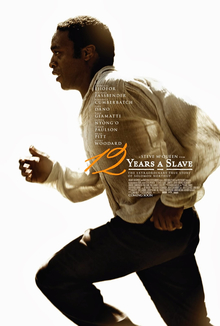
"12 Years a Slave" is an immensely powerful film. It's not a film that somebody really "loves" because it's too brutal to be loved. But it's also too important to ignore and gives us the most definitive perspective on America's ugly past with slavery thus far. So many of us sat through history class where we certainly were told about slavery, but it was never an emphasized portion of history. It was moreso, "this is something that happened, but it doesn't happen anymore" and it's often left at that. "12 Years a Slave" refuses to leave it at that and, quite frankly, it disturbs me the way a few detractors treat this film. This is a conventionally made film with a very unconventional approach to its treatment of violence and subject matter. It's conventional in its formalism, but unconventional in how it absolutely refuses to turn away from the violence it depicts. I'll admit, this makes for a very uneasy watch, but that doesn't make it a problematic film like some may say. Far from it. The fact of the matter is that we should be forced to see these violent acts, we should be seeing the film in this manner. Not only for what it means to us, but for what it means for the lead character, Solomon Northup.
Based on a true story, in 1841, Solomon Northup lives in Saratoga, New York with his wife and two children. He's a talented violinist and is lured into a touring gig by a pair of men while the rest of his family is out of town. After a drunken night out with these men in Washington, DC, Solomon finds himself alone, chained in a room he cannot escape from. He will soon find out that he has been kidnapped and sold into slavery, along with a couple of other young black men (as well as a woman and her two children) who are in similar situations.
And from there, the film begins its uneasy, uncomfortable journey into this darkness that is the American South. Yes, "12 Years a Slave" forces people to see what slavery actually entails. Human beings being made subservient to other human beings where any slip up or act of defiance and they can wind up dead. If they try to escape, they're dead. If they grieve for their children, who have been taken away from them, they're dead. If it is found out that they can read or write, they're dead. "12 Years a Slave" is about all that, yes, but most importantly, it's about how one man was able to endure all of this. He was able to endure all these horrific thoughts as a slave, trying his best to play the part to avoid certain death and yet, for some reason, he insists on surviving. Most importantly, he escapes. Then, amazingly, after all he goes through, he's able to write about his experiences. "12 Years" is, in many ways, about human endurance. It's about our natural propensity to want to live in spite of everything. It's about how, no matter how many horrific stories there are about slavery, about the holocaust, about any of these terrible events in this world, there is that one story about a person who is able to escape. That story reinforces the importance of the human condition, what makes us unique is our innate ability to survive despite seemingly impossible circumstances.
There's no sugarcoating or forced sentimentality in this film. Again, "12 Years a Slave" is a conventionally made film where its conventionality is juxtaposed with this horrific violence which not only reinforces the brutality that occurred in this era, but later, makes Solomon Northup's eventual escape that much sweeter and emotional. When he's finally able to escape and gets to see his wife and children for the first time, you won't find a more emotionally earned moment in cinema. It's an incredibly well-earned emotional scene because, man, we saw everything that he went through. Everything. We were right there with him.
We were forced to watch when he fought for his life while a noose tightly hangs around him. Thanks to the "good fortune" of having his feet being able to touch the ground, Solomon prevents certain death and keeps his toes tippying on the ground, keeping himself alive. But why? At that point in his life, why? Why continue living? Where other people may cry foul or call this particular scene gratuitous, I would have to whole-heartedly disagree. This is the single most important scene in the film. Not only does it show Solomon's inexplicable ability and will to survive but it also shows just how ordinary such an act is to the rest of the plantation. While he suffers, everyone else on the plantation just goes about the rest of their day. The scariest thing about "12 Years a Slave" isn't its depiction of brutality, it's how everyone else in the film responds to the brutality. It's incredibly unsettling to us and yet completely normal to all these other people. And in a way, that scene puts the camera on us. Why have we been able to deal with this dark period of our history with such indifference? And I'm not talking about "white guilt" or anything like that, I'm simply talking about those people who insist on saying that "slavery happened a long time ago" and that it's not even a conversation worth having with people. That today's African-Americans should refrain from even bringing it up because it happened so long ago. But when you're a young African-American and you're brought up into this country and you come to find out some of the horrific things your ancestors had to go through, how the hell are you supposed to act? How are you supposed to feel? What right do we have to tell them how they're supposed to feel?
"12 Years a Slave" would not be nearly as successful if not for the incredible acting all around. Chiwetel Ejiofor gives an incredible performance. He always plays the role with just the right balance that the role calls for. The whole film rests on him, too. If his performance doesn't work, the film is nowhere near as effective, but because he absolutely delivers, it elevates the film. Michael Fassbender is also very unsettling as Edwin Epps. What makes Fassbender such an amazing actor, and it's on full display here, is the sheer unpredictability. You can never pinpoint how he's going to react at any second and yet he gives this role such a focused, and at times, quiet intensity. The film is also well-served by great performances from Paul Dano, Paul Giamatti, Sarah Paulson, Lupita Nyong'o, and Benedict Cumberbatch.
I do have a few minor grievances with the film. Two, really. The first one would be the score from Hans Zimmer. While I did appreciate the unique approach to the instrumentation at times, I ultimately felt the score was too overbearing and overpowering at times when it wasn't really necessary. For me, the visuals were so powerful that it either didn't need such a big musical score behind it, or it could have been complemented with something more subtle that didn't call attention to itself. There were too many occasions where I felt that the score called attention to itself and didn't really add much more drama to what were already incredibly dramatic scenes. Sometimes a big musical score can be great and can help add emotion or layers to a film, but "12 Years a Slave" is already so inherently layered, that it just wasn't warranted in this case.
The other main grievance is the appearance of Brad Pitt. For me, Brad Pitt was more than a little distraction. He doesn't appear until the very end of the film, and while his role is important to the story, because he's such a big name actor and his role is so small, it did distract me. I greatly respect Brad Pitt and I know that his production company helped get the film made, but I think we could've done without his appearance here. He just didn't really add anything to the role that warranted his inclusion.
Steve McQueen has really turned into a special filmmaker. In just his third film, he's created such a clear through-line in his three works. All three of his films now, "Hunger", "Shame", "12 Years a Slave," are about men who go through unbelievably great trauma in order to achieve a certain goal. The goal isn't always positive or noble, especially in "Shame," but I think each film explores the sheer amount of abuse (physically, emotionally, sexually, physchologicall) we can take in order to prove something. Not to other people, but to ourselves. In "Hunger," it's a man going through a horrifying hunger strike to stand up for his convictions. In the end, who is he doing it for? In "Shame," it's a man who's need for sexual satisfaction leads him down a path towards self-destruction. He has an insatiable thirst for sexual stimulation. It's not something he wants, it's something he needs. It's pure, unadulterated, unemotional, animalistic sex. It's a film that explores just how inhuman sex can be when put through this lens.
And finally, "12 Years a Slave" is about a man's inexplicable need or desire to stay alive despite the fact that all hope is essentially lost. It's all there in the title. 12 YEARS. That's an entire run of education for most people, from 1st grade to high school graduation. After year 5, why would he insist upon himself that he must keep living? And when he finally does escape the plantation, it's not without the thought that he's leaving behind dozens of people who will remain enslaved until they die. They have no hope. They have no plausible method to escape. There's no way for them to become free. But, after 12 years, he can't weep for them. He must find a way to find some solace in his freedom. And thankfully, by writing about his experiences, his story will live on forever. His story, a reflection on so many similar stories that don't have happy endings, is a happy ending. Finally, he's able to justify his actions because he made it. His need to continue living will not be for nothing.
I deeply respect and admire the way McQueen handled this film. A director who, in his first two films had the tendency to be a little too self-indulgent, shows remarkable restraint here. He lets the story speak for itself and yet, at the same time, this is very much his movie. Not just in the way it relates thematically to his other films, but the fact is his unflinching style is very much still at play here. This is a story that played perfectly into Steve McQueen's strengths as a filmmaker who is absolutely unafraid to keep the camera running when the audience demands that he cut. "12 Years a Slave" is absolutely essential viewing because it approaches its subject matter with absolute fearlessness. There are many times throughout the film that you will want to turn away, but you shouldn't. Because, at the end, when Solomon Northup is finally free and you get to feel what he feels? What an unbelievable rush.
Grade: A
Subscribe to:
Posts (Atom)